
Tube Laser
Tube laser vs saw-and-drill for structural fabrication
An honest breakdown for structural fabricators: the operations, accuracy, and geometry that decide whether tube laser or saw-and-drill quotes cheaper — and where saw-and-drill still wins.
By Nevatronix Laser 8 min read
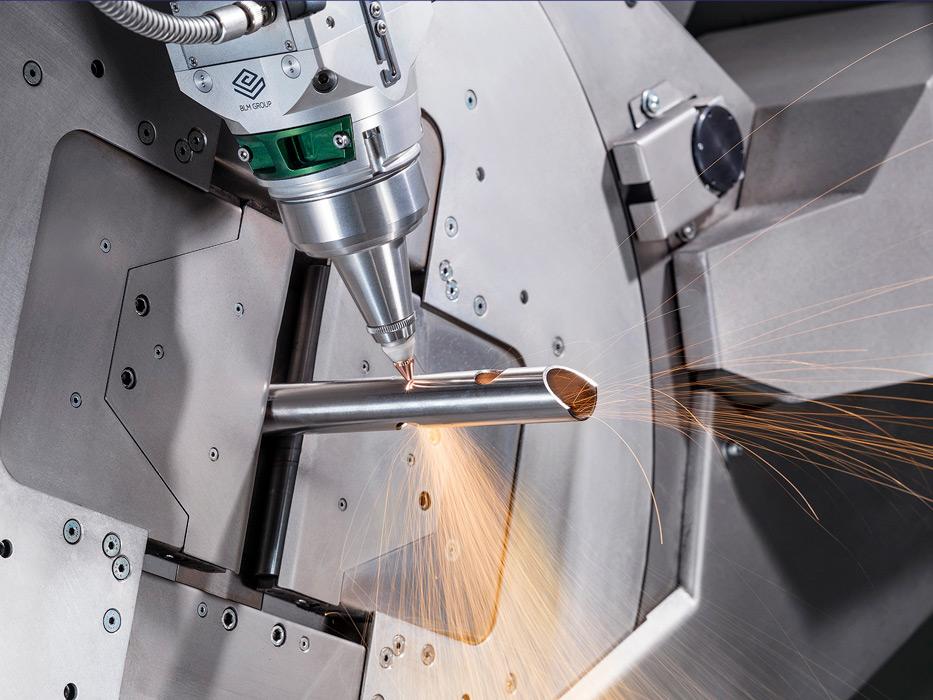
Tube laser cutting becomes cheaper than saw-and-drill the moment a part carries more than about two features — holes, slots, copes, or angled ends. One laser program cuts every feature off a single datum in one setup, replacing the saw, deburr, layout, drill, and coping operations that fabricators otherwise run on separate machines.
What’s the actual difference?
Tube laser cutting loads a length of tube or structural section into a chuck, rotates and advances it under a fiber laser head, and cuts holes, slots, copes, miters, and profiles anywhere on the surface in a single automated program. Saw-and-drill is the traditional structural workflow: a cold saw or bandsaw cuts the tube to length, an operator lays out and center-punches the hole locations, a drill press or mill drills them, a separate operation copes or notches the ends, and every cut edge gets deburred by hand.
The difference that drives every quote below is setups. Saw-and-drill touches the part on four to eight separate machines, each needing its own fixture, datum, and round of operator handling. Tube laser touches it once. Our tube laser cell is a 6 kW fiber source with a five-axis head and a two-chuck auto-loader, so cut-to-length, drilling, coping, mitering, and part marking all collapse into one program — the same fiber technology we break down in fiber vs CO2 laser cutting.
Which process consolidates more operations?
This is the whole comparison in one table. Track a single tube part through both workflows:
| Operation | Saw-and-drill | Tube laser |
|---|---|---|
| Cut to length | Cold saw or bandsaw, own setup | In the program |
| Locate holes | Manual layout + center punch | Off a common datum, no layout |
| Drill / punch holes | Drill press or mill | Cut in the same pass |
| Copes, notches, saddles | Coping mill or hand grinder | Cut in the same pass |
| Miters and angled ends | Re-set the saw, second cut | Cut in the same pass |
| Part marking | Separate stamp or label | Laser-etched in the same pass |
| Deburr | Hand-deburr every edge | Minimal — clean laser edge |
| Setups / machines | 4–8 | 1 |
The consolidation is the story. When one program cuts the length, every hole, each cope, the end miters, and the traceability mark in a single setup, the labor that saw-and-drill spreads across a shop floor disappears. For any tube part with two or more holes, slots, miters, or angled cuts, that typically means a 60–80% reduction in piece-part labor and a 90%+ reduction in setup cost once it’s amortized across the lot.
How does accuracy compare across setups?
Every time a part moves to a new machine, it is re-fixtured against a new datum, and the small errors compound — a phenomenon called tolerance stack-up. A hole drilled 0.3 mm off the saw cut, on a length that was itself cut 0.5 mm long, on a cope located by eye, adds up to a member that fights the welder and pulls the assembly out of square.
Tube laser locates every feature off one datum in one setup, so the stack never accumulates. Hole position holds ±0.1 mm feature-to-feature regardless of part complexity, and length holds ±0.2 mm. That precision matters most where holes have to register against a mating part — bolt patterns, cross-member connections, and pass-throughs that a structural detailer dimensioned to the fit-up tolerances behind AISC 360 and AWS D1.1. When those features are cut off a single datum, the parts go together the way the model says they should, and a first-article check confirms it once rather than at every station.
Consider a cross-member with four bolt holes at each end that has to bolt to two mating uprights. Saw-and-drill introduces independent error at the length cut, at the layout, and at the drill, so in the worst case they add and the field crew reams a hole out on site. Cut on the laser, all eight holes and both end copes reference the same zero, and the member drops onto the uprights with the bolts starting by hand. The laser also etches the part number and lot code in the same pass, so traceability is built into the cut rather than added as a downstream stamping operation.
What geometry can tube laser cut that saw-and-drill can’t?
This is where a tube laser stops being a faster saw and becomes a different capability. Saw-and-drill is limited to straight cuts and round holes; the laser cuts any profile, at any orientation, anywhere on the tube.
- Copes and saddle joints. Where a round tube meets another round tube, the joint needs a saddle (fishmouth) profile. Saw-and-drill shops cut these on a dedicated coping machine or grind them by hand. The laser cuts the exact saddle — including compound angles — as part of the same program.
- Weld bevels. Joint preparation that a fabricator would otherwise grind on can be cut as a weld-ready bevel in the same pass, so the tube reaches the welder needing no pre-weld prep beyond cleaning.
- Tab-and-slot joints. This is the highest-leverage feature on the list. The laser cuts interlocking tabs on one member and matching slots on the other, so the parts self-locate and self-square when assembled — like flat-pack furniture. A weldment that used to need a custom welding jig now clamps to itself. That removes fixturing time, tightens repeatability across a run, and lets a less specialized welder run the joint because the geometry holds the alignment, not the operator.
- Angled ends and hole patterns at any orientation. Compound miters, birdsmouth ends, and hole patterns that wrap around the corner of a square tube are just coordinates in the program. Saw-and-drill would need a tilting fixture and a fresh setup for each of them.
None of these are achievable with a saw and a drill press without adding still more operations. On the laser they cost nothing extra — they are just more lines in the same program.
When does tube laser cutting become cheaper?
Tube laser carries a real fixed cost: programming and a first-article part. Saw-and-drill carries a real variable cost: every hole is a separate drilling operation and every cope a separate setup. Those two cost curves cross at a surprisingly low feature count.
| Part profile | Lower-cost process | Why |
|---|---|---|
| Cut-to-length only, no features | Saw-and-drill | Nothing for one setup to consolidate |
| One hole, square ends | Roughly even | One drilling op vs one program |
| Two-plus holes, or any cope, slot, or miter | Tube laser | One setup replaces four to eight |
| The same part repeated across a lot | Tube laser (gap widens) | Setup cost amortizes toward zero |
The lot size tilts it further. Programming and first-article are one-time costs; spread across a production run they approach zero per part, while saw-and-drill pays its per-feature labor on every single piece. A part that’s a toss-up as a one-off is decisively cheaper on the laser at fifty pieces. On our cell that shows up in the lead time too — a five-day prototype turn to prove the program, then production runs where the setup no longer moves the price.
When saw-and-drill still wins
Tube laser is not the answer to every structural part, and pretending otherwise would waste your money. Saw-and-drill is the right call in four cases:
- Simple square cuts with very few features. Plain cut-to-length stock, or a member with a single hole, has nothing for the laser’s single-setup advantage to consolidate. A saw is faster to set up than the part is to program.
- Walls beyond machine capacity. Our tube cell cuts to a 12 mm wall. Heavier structural sections with thicker walls belong on a saw and a mag drill.
- Sections beyond the envelope. Round tube larger than 220 mm outside diameter, or box section larger than 200 × 200 mm, is outside the cell. For oversized profiles we coordinate with a partner facility rather than force the geometry.
- A single piece already on a machine shop’s floor. If the tube is a genuine one-off and it’s already fixtured on a mill, the programming and first-article overhead may not pay back against just finishing it where it sits.
If your part sits in any of those buckets, we’ll tell you — and where it makes sense, point you to the process or vendor that quotes it cheaper.
When tube laser wins (most multi-feature parts)
For the structural work that actually lands in our quote inbox — welded frames and chassis, handrail and architectural railing, trailer and equipment frames, machine and cabinet sub-frames — the part almost always carries more than two features, and tube laser wins across the board:
- Operations consolidated. One setup replaces the saw-drill-cope-deburr chain, cutting piece-part labor 60–80%.
- Accuracy. Every feature off one datum, ±0.1 mm hole position, no tolerance stack-up into the weld fixture.
- Geometry. Copes, saddles, weld bevels, and tab-and-slot self-fixturing joints that a saw and drill simply can’t produce.
- Material coverage. Mild steel tube (HSS, ERW, DOM), stainless 304/316, aluminum extrusion, and structural channel, angle, and I-beam — from a single prototype through 50,000-piece production out of our Las Vegas, ISO 9001:2015 shop.
For most tube-based assemblies, the multi-feature reality of real parts is exactly what tube laser is built for.
How we’d quote your part
Send a STEP file of the tube or the full weldment with material, wall thickness, and quantity to our quote page. We’ll tell you the honest crossover: if it’s a plain cut-to-length, we’ll say saw-and-drill is cheaper. If it carries copes, patterns, or tab-and-slot joints, we’ll show you the single-setup number.
References
- ANSI/AISC 360 — Specification for Structural Steel Buildings (AISC Steel Construction Manual)
- AWS D1.1/D1.1M — Structural Welding Code: Steel
- ASTM A500/A500M — Cold-formed welded and seamless carbon steel structural tubing in rounds and shapes (HSS)
- AISI — American Iron and Steel Institute, carbon and structural steel resources
- FMA International — Fabricators & Manufacturers Association, tube and pipe fabrication resources
Frequently asked questions
- When is tube laser cutting cheaper than saw and drill?
- The moment a tube part carries more than about two features — holes, slots, copes, or angled ends. One laser program cuts every feature off a single datum in one setup, replacing the saw, layout, drill, cope, and deburr operations that saw-and-drill runs on separate machines. On our cell that's typically a 60–80% cut in piece-part labor and 90%+ on setup cost across the lot. Below two features — a plain cut-to-length with maybe one hole — saw-and-drill usually still wins.
- How many operations does a tube laser replace?
- Four to eight. Saw-and-drill cuts to length on a saw, lays out and center-punches holes, drills them on a press or mill, copes or notches the ends on a separate machine, marks the part, and hand-deburrs every edge. Our five-axis tube cell does all of that — cut-to-length, every hole, each cope and miter, and the etched part number — in one program and one setup.
- Can a tube laser cut copes and saddle joints for weld prep?
- Yes. The five-axis head cuts saddle (fishmouth) profiles, compound miters, and weld bevels in the same setup as the through-holes and slots. Tubes arrive at the welding cell needing no pre-weld prep beyond cleaning, which removes the coping machine and hand-grinding from the workflow entirely.
- What tube sizes and wall thickness can you laser cut?
- Round tube from 12 to 220 mm outside diameter, square and rectangular section up to 200 × 200 mm, and structural shapes like channel, angle, and I-beam. Maximum wall thickness is 12 mm and maximum length is 6.2 m (244 in). Materials include mild steel tube (HSS, ERW, DOM), stainless 304/316, and aluminum extrusion.
- When is saw-and-drill still the better choice?
- Four cases: plain cut-to-length stock with zero or one feature; walls thicker than our 12 mm capacity; sections larger than 220 mm round or 200 × 200 mm; and one-off pieces already sitting on a machinist's mill, where the programming and first-article overhead won't pay back on a single part.
- Does tube laser cutting hold tighter tolerances than saw and drill?
- Yes, because it avoids tolerance stack-up. Saw-and-drill re-fixtures the part against a new datum at every machine, and the errors add up. Tube laser locates every feature off one datum in one setup, holding ±0.1 mm on hole position feature-to-feature regardless of part complexity, and ±0.2 mm on length.
- How does tab-and-slot design reduce welding cost?
- The laser cuts interlocking tabs on one member and matching slots on another, so the parts self-locate and self-square when assembled — like flat-pack furniture. A weldment that used to need a custom jig now clamps to itself, which cuts fixturing time, improves repeatability, and lets a less specialized welder run the joint.