
Process Selection
Fiber vs CO2 laser cutting
A fiber shop's honest comparison for procurement engineers — material compatibility, edge quality, throughput, operating cost, and where CO2 still wins.
By Nevatronix Laser 8 min read
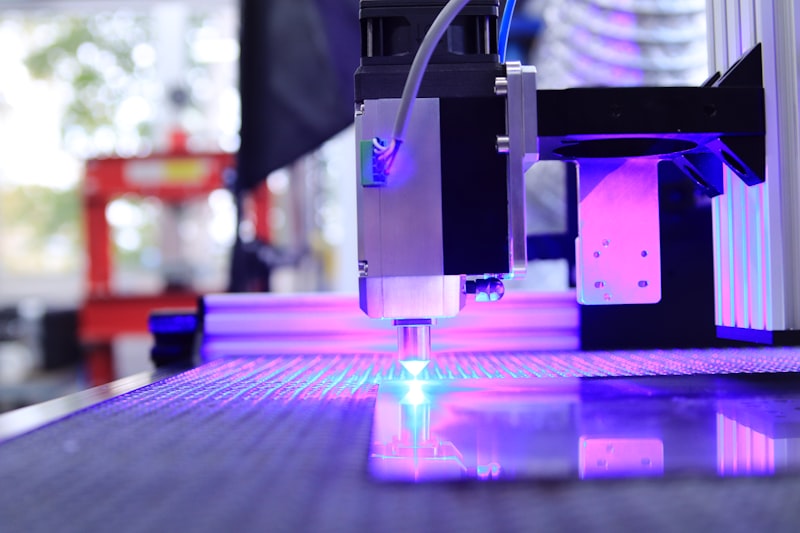
The short answer for almost any procurement decision in 2026: if you’re cutting metal under 15 mm thick, fiber wins on cost, speed, and edge quality. CO2 holds a narrow set of specific use cases — mainly non-metals, very thick stainless above 20 mm, or shops with existing CO2 capital that still pencils out. The rest of this page is the detail behind that one-sentence answer.
What’s the actual difference?
A fiber laser generates its beam in a glass fiber doped with ytterbium and delivers it through that same fiber to the cutting head. A CO2 laser generates its beam in a sealed tube of carbon dioxide gas and delivers it through a series of mirrors. Same job — cut metal with concentrated light — different physics, different optimal materials, and different cost structure.
The two wavelengths matter more than anything else in the comparison. Fiber at 1.06 μm couples efficiently into metals, especially reflective ones like aluminum, brass, and copper. CO2 at 10.6 μm couples into non-metals (acrylic, wood, leather) where fiber reflects off. That single physical fact drives most of the rest of the decision tree.
Material compatibility at a glance
| Material | Best fit | Practical range at 3 kW fiber | Notes |
|---|---|---|---|
| Mild steel | Fiber | Up to 12 mm | Oxygen assist for thicker, nitrogen for cleaner edges |
| Stainless 304/316 | Fiber | Up to 6 mm | Nitrogen assist standard for weld-ready edges |
| Stainless 430 | Fiber | Up to 6 mm | |
| Aluminum 5052/6061 | Fiber | Up to 5 mm | Fiber dominant; CO2 struggles with reflectivity |
| Brass | Fiber | Up to 3 mm | Modern fiber handles reflective metals safely |
| Copper | Fiber (modern) | Thin sheet | Required higher fiber kW until recently; common now |
| Galvanized steel | Fiber | Up to 6 mm | Both technologies work; fiber faster |
| Pre-painted / coil-coated | Fiber | Up to 6 mm | Lower HAZ on fiber preserves coating better |
| Acrylic (PMMA) | CO2 only | Any | Fiber wavelength reflects off acrylic — will not cut |
| Wood, paper, leather, fabric | CO2 only | Any | Non-metals — fiber wavelength wrong |
| Stainless > 20 mm | CO2 (narrowing) | Above 20 mm | Edge-quality gap closing fast at higher fiber kW |
The procurement takeaway: if every part on your bill of materials is metal under 15 mm, you can almost certainly source it from a fiber shop. If your list includes acrylic, wood, or other non-metals, you need a CO2 shop or a different process entirely. Mixed lists are common — many shops run fiber alongside a small CO2 cell to handle the occasional non-metal job, but few buy new CO2 for metal cutting in 2026.
Edge quality and tolerance
Both technologies produce edges classified under ISO 9013, the international standard for thermal cutting quality. ISO 9013 ranks edges 1–5 across two parameters: perpendicularity and angularity tolerance (range 1 is tightest), and mean surface roughness. Range 2 — the typical production result on our fiber cell — covers parts that go straight to welding, assembly, or powder coat without secondary deburring on most cuts.
The practical edge differences:
- Kerf width. Fiber kerf is typically 0.1–0.3 mm depending on focal optics and thickness; CO2 kerf is typically 0.2–0.6 mm. Narrower kerf means less material lost per cut and finer detail features — meaningful when min hole diameter matters or material yield drives part cost.
- Heat-affected zone (HAZ). Fiber HAZ is usually 50–80% smaller than CO2 at comparable thickness. Matters for parts that go to subsequent forming or welding: less hardening at the cut edge, less distortion during downstream operations.
- Edge perpendicularity. Both can hit ISO 9013 range 2 in skilled hands. Fiber holds it more consistently as thickness drops below 6 mm, where CO2 kerf taper starts becoming visible.
- Dross. Fiber’s tighter focus produces less bottom-edge dross on mild steel cut with nitrogen. CO2 oxygen-cut mild steel can have slightly cleaner top edges at thicker gauges — one of the narrow cases where CO2 has a remaining edge.
On our fiber cell at 3 kW, ±0.05 mm position and profile tolerance is the typical hold, with ±0.025 mm repeatability between parts in a production run. Min hole diameter is 1 mm. Tighter tolerances are available on request.
Throughput at typical production thickness
Cut speed is the line item that moves unit cost the most on production runs. Approximate cut speeds at production settings:
| Material × thickness | Fiber 3 kW (m/min) | CO2 3–4 kW (m/min) | Fiber advantage |
|---|---|---|---|
| Mild steel 1 mm | 30+ | 8–10 | 3–4× |
| Mild steel 3 mm | 7–9 | 3–4 | ~2× |
| Mild steel 6 mm | 3–4 | 2.0–2.5 | ~1.5× |
| Mild steel 12 mm | 0.8–1.2 | 0.7–1.0 | ~1.1× |
| Stainless 1 mm | 20+ | 5–6 | 3–4× |
| Stainless 6 mm | 1.5–2.0 | 1.0–1.2 | ~1.5× |
| Aluminum 3 mm | 5–7 | 1.5–2.5 (reflectivity) | 2–3× |
| Aluminum 6 mm | 1.5–2.0 | Marginal | Significant |
These are typical ranges, not guarantees — exact speed depends on alloy grade, assist gas pressure, focal position, optics condition, and the specific machine. The pattern, though, is consistent: the fiber-to-CO2 throughput gap is widest at thin gauges and narrows as material thickens.
The procurement implication runs against intuition. Spec sheets list maximum cut thickness, which makes the two technologies look comparable. The real cost difference shows up below 3 mm, where a high-volume run of thin parts on fiber will finish in a fraction of the CO2 cycle time at similar or lower shop rates. For most production sheet metal work, that’s where the unit-cost gap opens up.
Operating cost and cost of capital
Three cost levers separate fiber and CO2 in practice.
Wall power. A 3 kW fiber system pulls roughly 12–15 kW from the wall — beam-to-mains efficiency around 25–30%. A comparable 3–4 kW CO2 system pulls 70–100 kW — efficiency under 10%. On a 2,000 hour/year shift schedule, the difference is on the order of 100,000 kWh annually. At industrial power rates that’s a meaningful annual line item before any other operating cost.
Assist gas. Both technologies use nitrogen and oxygen for assist gas at comparable consumption per linear meter. No structural difference here — gas cost tracks volume, not laser type.
Consumables. Fiber lasers have very few consumables: nozzle tips, protective lens covers (the “cover slide” that protects the cutting head), and the chiller filter. Manufacturer-rated service intervals on fiber sources are commonly 20,000–100,000 hours of laser-on time before any meaningful event. CO2 lasers require periodic mirror cleaning, gas mixture replenishment, and laser tube replacement at a smaller hour count — typically 8,000–20,000 hours depending on tube design and duty cycle.
Cost of capital. New fiber systems at 3–4 kW currently run roughly $250K–$500K depending on bed size and features. New CO2 systems at comparable cutting capability run roughly $150K–$300K, though that gap has narrowed every year for the last decade. Used CO2 equipment is much more available on the secondary market — one reason some shops still run CO2 alongside fiber. For shops buying new, fiber has been the default purchase for sheet metal cutting since roughly the late 2010s.
Add it up: lower power draw, fewer consumables, longer service intervals, and slightly higher capex that pays back inside 2–4 years on typical production volumes. The total cost of ownership math is why fiber has displaced CO2 as the new-purchase standard.
When CO2 still wins
CO2 isn’t dead, and pretending otherwise would be dishonest. Three cases where CO2 is still the right answer:
- Cutting non-metals. Acrylic, wood, paper, leather, fabric, certain rubbers and foams — fiber’s 1.06 μm wavelength reflects off these materials or doesn’t couple efficiently. CO2 at 10.6 μm absorbs cleanly. If any part on your list is a non-metal, fiber can’t help and you need CO2 or a waterjet.
- Very thick stainless above ~20 mm. Some CO2 systems still produce a slightly cleaner edge on very thick stainless cut with nitrogen, particularly at gauges above 20 mm. The gap is closing fast as fiber wattage climbs past 12 kW, and below 12 mm the edge quality is equal or better on fiber. But at the extreme thick end, an experienced CO2 operator can sometimes still beat a fiber edge.
- Existing capital and supply chains. If a shop already runs reliable CO2 equipment with a long maintenance and consumables track record, the replacement math doesn’t always pencil out. Used CO2 equipment remains plentiful and serviceable on the secondary market. The math changes for new purchases — the industry has effectively stopped buying new CO2 for industrial sheet cutting.
When fiber wins (almost everything else)
For sheet metal under roughly 20 mm, fiber wins on virtually every axis that matters to procurement:
- Cycle time at common production thicknesses (1–6 mm) is 2–4× faster.
- Operating cost per part is materially lower, driven primarily by wall power and consumables.
- Reflective metals — aluminum, brass, copper — cut cleanly on fiber, which is a structural problem for CO2.
- Tube cutting at any reasonable diameter — multi-axis fiber tube cells are now the production standard. CO2 tube cutting is rare on new builds.
- Edge quality at typical production thickness consistently meets ISO 9013 range 2.
- Footprint and ramp-up on a new install is shorter.
If your part sits in any of those buckets — and most production sheet metal does — fiber is almost certainly the right tool.
How we’d quote your part
Send a DXF or STEP file with material grade, thickness, and quantity ranges to our quote page. One business day turnaround on most jobs. If the part is non-metal or thick stainless above the range where fiber wins, we’ll say so and recommend a different process or vendor — that’s the point of writing for procurement engineers.
References
- ISO 9013:2017 — Thermal cutting: classification of thermal cuts and edge quality
- ASTM B209 — Standard specification for aluminum and aluminum-alloy sheet and plate
- ASTM A480 — Standard specification for flat-rolled stainless and heat-resisting steel plate, sheet, and strip
- AWS standards catalog — laser beam welding, cutting, and allied processes
- Fabricators & Manufacturers Association International — laser cutting industry resources
Frequently asked questions
- Which is better for stainless steel, fiber or CO2 laser?
- Fiber, in almost every case under 12 mm thickness. Fiber holds ISO 9013 range 2 edge quality on stainless, runs 2–4× faster at thin gauges, and produces a cleaner weld-ready edge with nitrogen assist. CO2 still has marginal advocates above 20 mm stainless, but most production stainless cutting today is fiber.
- Can a fiber laser cut acrylic?
- No. Fiber laser wavelength (about 1.06 micrometers) reflects off transparent and translucent plastics like acrylic instead of being absorbed. CO2 laser wavelength (10.6 micrometers) absorbs cleanly into acrylic and is the right tool for that material. If your part list includes acrylic, you need CO2 or a different process.
- Is fiber laser cheaper to operate than CO2?
- Yes, materially. Fiber draws roughly 12–15 kW from the wall at 3 kW beam power versus 70–100 kW for an equivalent CO2 system — about 5–6× more energy-efficient at the beam. Fiber also has fewer consumables: no laser tube replacement, no mirror cleaning, no gas mixture maintenance. Annual operating cost is typically 30–50% lower.
- What thickness can a 3 kW fiber laser cut?
- On our cell at 3 kW: mild steel to 12 mm, stainless to 6 mm, aluminum to 5 mm. Higher-kW fiber systems extend these ranges — 12 kW units cut mild steel past 25 mm — but the 3 kW range covers the bulk of production sheet metal work for procurement audiences.
- Do CO2 lasers still make sense in 2026?
- Yes, in three specific cases: cutting non-metals (acrylic, wood, leather), cutting very thick stainless above roughly 20 mm where the edge-quality gap is narrow, and shops with existing CO2 capital and supply chains that already work. Almost no one buys new CO2 for industrial sheet cutting in 2026 — fiber has won the new-equipment market.
- Why is fiber faster than CO2 on thin material?
- Two reasons. Fiber's higher beam quality (lower mode order, tighter focal point) deposits more power in a smaller spot. And fiber's higher wall-plug efficiency means more of the system's rated power reaches the workpiece. On 1 mm mild steel, a 3 kW fiber typically cuts at 30+ m/min versus 8–10 m/min for a comparable CO2.
- Which laser cuts aluminum better, fiber or CO2?
- Fiber, clearly. Aluminum reflects CO2 wavelength strongly — historically aluminum was a problem material for CO2 lasers, requiring lower speeds and risking back-reflection damage to the laser source. Fiber wavelength absorbs better into aluminum and cuts it at production speed. We cut aluminum to 5 mm at 3 kW with nitrogen assist.