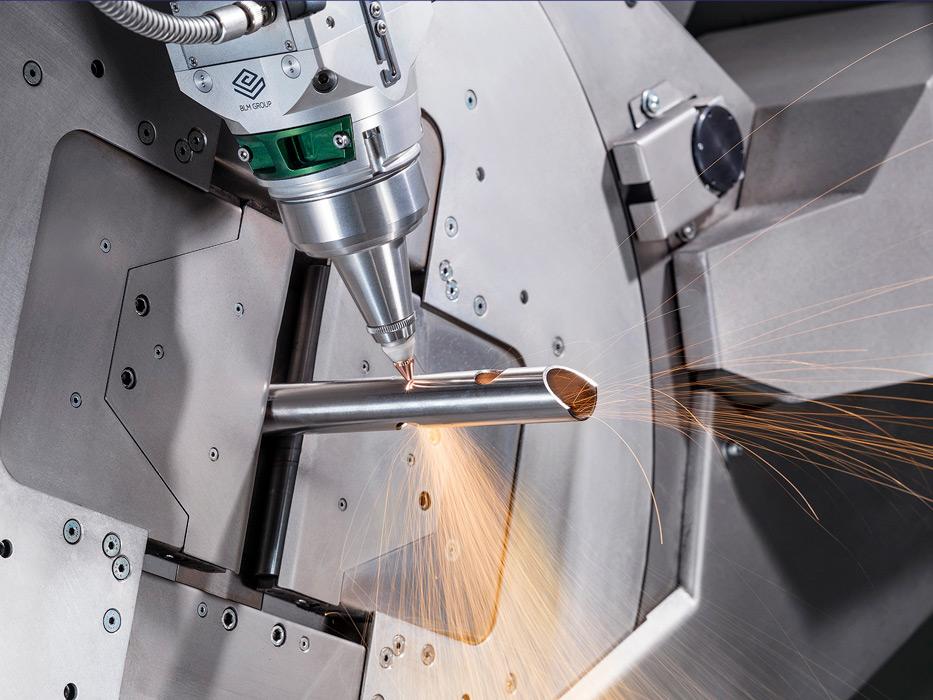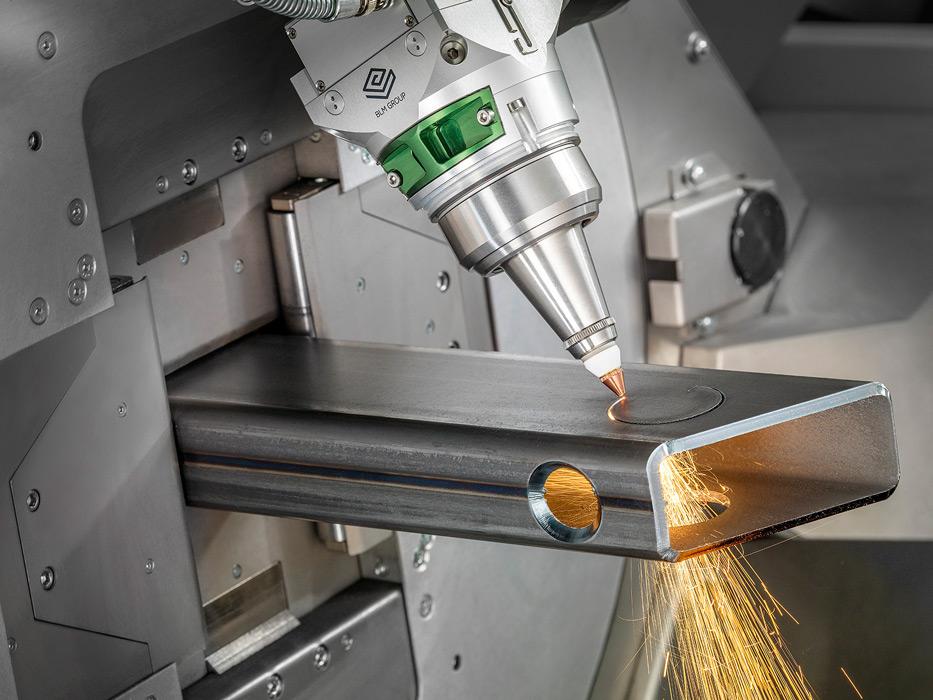
Tube laser cutting collapses what used to be a multi-station workflow — saw, drill, deburr, mitre — into a single setup. For frames, railings, structural sub-assemblies, and any tube-based part with more than two features, the cost-and-time math typically lands in tube laser’s favor by a wide margin.
Capability envelope
- Round tube OD range
- 12 – 220mm
- Square/rect section
- up to 200 × 200mm
- Max wall thickness
- 12mm
- Max length
- 6.2m
- Axes
- 5
- Position tolerance
- ±0.1mm
- Length tolerance
- ±0.2mm
Tube and section profiles we cut
The cell runs four families of stock, each with its own design considerations. Two of them have their own detail pages:
- Round tube — 12 to 220 mm outside diameter. The rotary axis wraps holes, slots, and copes anywhere around the circumference, which is what makes clean tube-to-tube saddle joints possible in a single program.
- Square and rectangular tube — 15 × 15 up to 200 × 200 mm section. Flat faces make square and rectangular tube the workhorse of welded frames and cabinet skeletons, with features that wrap around the corners in one setup.
- Structural sections — channel, angle, and I-beam, plus precision angle and channel cutting for framing, supports, and rails.
- Materials — mild steel tube (HSS, ERW, DOM), stainless 304/316, and aluminum extrusion (6061, 6063).
Across all of them the envelope is the same: up to 12 mm wall thickness and 6.2 m (244 in) length, with hole position held to ±0.1 mm and length to ±0.2 mm.
Coped, mitered, and notched joints
This is where a tube laser stops being a faster saw and becomes a different capability. The five-axis head cuts any profile at any orientation on the tube, so joints that a fabricator would otherwise cut on separate machines are just more lines in the same program:
- Copes and saddle joints. Where a round tube meets another round tube, the joint needs a saddle (fishmouth) profile. The laser cuts the exact saddle — including compound angles — instead of grinding it by hand or running a dedicated coping machine.
- Miters and angled ends. Compound miters, birdsmouth ends, and angled cuts come off the program without re-setting a saw for each one.
- Notches and tab-and-slot features. Interlocking tabs on one member and matching slots on another let parts self-locate and self-square at assembly — like flat-pack furniture — so a weldment that used to need a custom jig now clamps to itself.
Weld-ready joint preparation
Because the same head that cuts the holes also cuts the joint geometry, tubes arrive at the welding cell needing no pre-weld prep beyond cleaning. Weld bevels, root faces, and saddle profiles are cut to the fit-up the joint calls for, which removes the coping machine and hand-grinding from the workflow entirely. For frame assemblies bound for our sheet metal welding and finishing cells, that means a tube → weld → finish path with zero secondary machining.
Fit-up accuracy vs saw-and-drill
The accuracy advantage over saw-and-drill is not marginal — it comes from eliminating tolerance stack-up. Every time a part moves to a new machine it is re-fixtured against a new datum, and the small errors compound: a hole drilled slightly off a length that was itself cut slightly long, on a cope located by eye, adds up to a member that fights the welder and pulls the assembly out of square.
Tube laser locates every feature off one datum in one setup, so the stack never accumulates. Hole position holds ±0.1 mm feature-to-feature regardless of part complexity, and length holds ±0.2 mm. On a cross-member with bolt holes at each end that has to register against two mating uprights, that is the difference between the bolts starting by hand and a field crew reaming a hole out on site. The laser also etches part numbers and lot codes in the same pass, so traceability is built into the cut rather than added downstream.
What single-setup buys you
When the laser cuts every hole, slot, miter, and orientation mark in one pass, three downstream things change:
- Setup amortization disappears. A drilled-and-sawed tube part has 4–8 separate operation setups; the laser has one.
- Tolerance stacks reduce. Every hand-off introduces error. Laser-cut tubes hold position tolerance from feature to feature at ±0.1 mm or better, regardless of how complex the part is.
- Weld prep is built in. Saddle joints, bevels, and bevel-with-root-face arrive at the welder ready to clamp and run.
Applications
Tube laser cutting is built for multi-feature structural parts. The work that runs through the cell most often:
- Welded frames and chassis — equipment frames, machine bases, and sub-assemblies where holes, slots, and copes have to register for weld-up.
- Kiosk and cabinet skeletons — the structural tube frame behind gaming cabinets, vending machines, and payment kiosks.
- Transit and rail structures — framing, supports, and brackets for transportation equipment where repeatable fit-up matters across a production run.
- Storage and material-handling racking — repeated frame members where single-setup accuracy and part marking pay off across the lot.
- Handrail and architectural railing — round and square railing with clean, code-conscious joints.
For any tube-based part carrying more than about two features — holes, slots, copes, or angled ends — the single-setup math lands in tube laser’s favor. For a plain cut-to-length with one hole, a saw is still faster, and we will tell you so.