
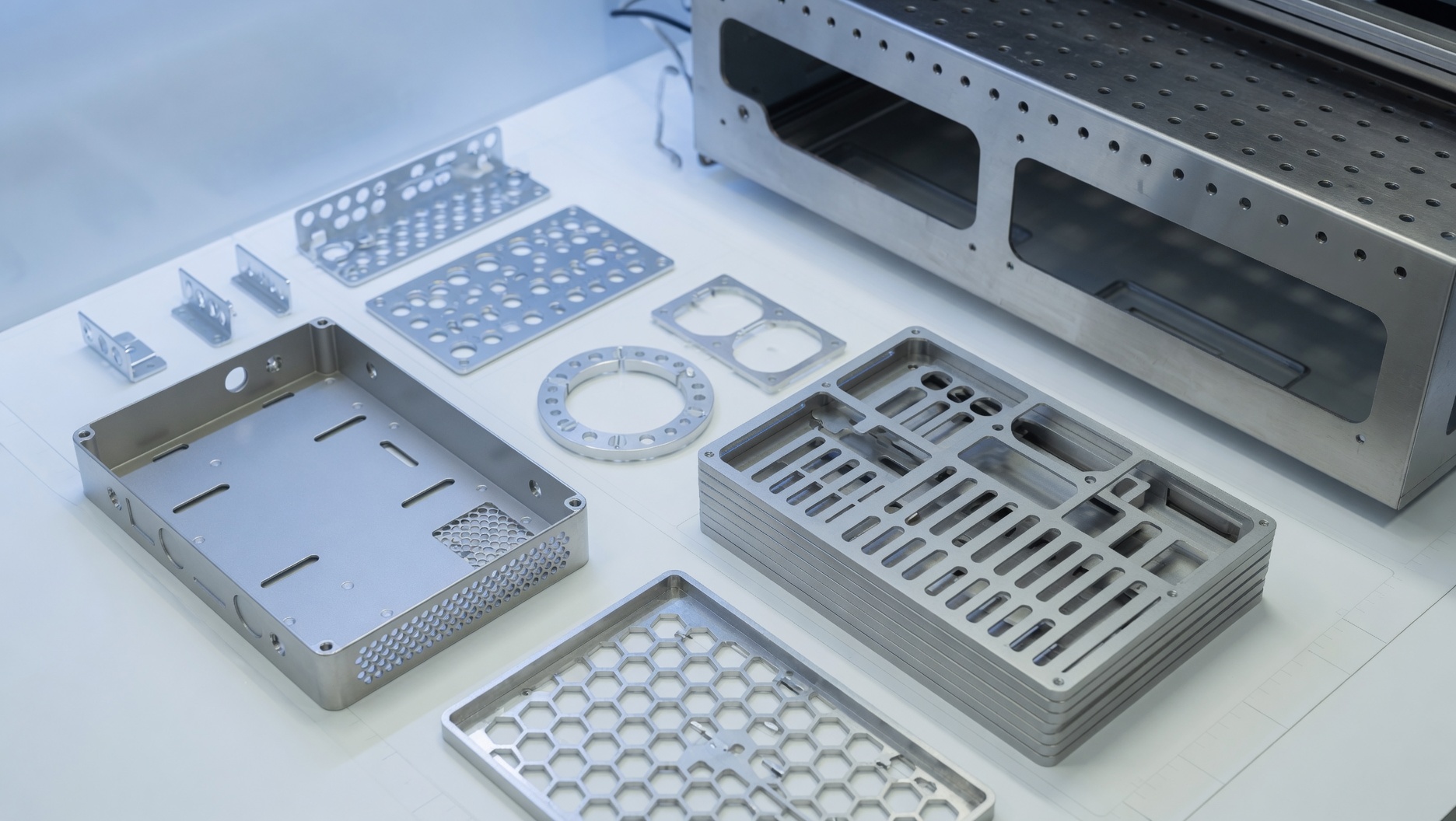
Medical device customers buy documentation and tolerance, not raw volume. Nevatronix Laser cuts the metal components that go into a device maker’s own assembly — device enclosures, surgical tray inserts, lab-equipment chassis, and precision stainless and aluminum parts — to the device maker’s print, under our own ISO 9001:2015 quality system, not theirs, and with the certification limits stated plainly rather than implied.
What we cut for medical device and lab equipment programs
Device and lab-equipment programs draw on a narrow, repeatable set of part families:
- Device enclosures and chassis. The structural housing a device maker’s own assembly builds into a finished unit.
- Surgical instrument tray inserts. Flat-sheet inserts with tight-fitting instrument cutouts.
- Lab analyzer and lab-equipment chassis. Panels and frames for benchtop and lab-floor equipment.
- Precision stainless components. 304 and 316 as standard, 316L on request for welded assemblies.
- Precision aluminum components. Lightweight panels and brackets where weight matters.
- Hospital and lab equipment housings. Cart, cabinet, and mobile-equipment panels.
- Sterilization-compatible tray and cutout patterns. Nitrogen-cut, oxide-free edges suited to downstream autoclave or gamma processing the device maker controls.
What tolerance do device enclosures and tray inserts need?
±0.05 mm on profile and hole position is the standard on our flat sheet laser cutting cell, holding ±0.025 mm repeatability across a production run. That covers most enclosure seams and tray-insert instrument pockets without a secondary operation. Where a specific feature needs tighter control, we hold it on request and document the result on the first-article inspection report rather than promise it as a blanket spec.
Which stainless grade fits a medical component?
304 is the general-purpose default for enclosures and panels; 316 adds molybdenum for better resistance where cleaning chemicals or chloride exposure are frequent; 316L is available on request for parts that get welded, since its lower carbon content reduces carbide precipitation at the weld zone. All three run on the same stainless steel cell up to 6 mm, cut with nitrogen assist for the bright, oxide-free edge medical customers specify — see our nitrogen vs. oxygen assist gas comparison for why that matters. Aluminum up to 5 mm covers components where weight outweighs the need for stainless’s corrosion resistance.
Are you ISO 13485 certified or FDA registered?
No to both. We operate under ISO 9001:2015 and do not hold ISO 13485 certification or an FDA establishment registration. We are a component fabricator, not a device manufacturer — we cut to your qualified design, and the device maker’s own quality system, design controls, and regulatory submission carry the ISO 13485 and FDA scope. That boundary is deliberate: it is why device OEMs use us as a supplier into their system rather than a substitute for it, and it is worth stating plainly rather than letting a vague “medical-grade” claim imply certifications we do not hold.
How fast can a device enclosure or tray insert prototype turn?
A flat-sheet prototype — enclosure, tray insert, or chassis panel — turns in 48–72 hours in standard materials once the file is quote-ready. Production orders on the same file run 5–10 business days, at volumes from a single prototype up to 50,000 units per release, with no re-quote required when the design carries forward unchanged. That timeline holds for stainless and aluminum alike, since both run on the same 3 kW fiber cell at the same tolerance.
How do you document lot traceability and material certs?
Every job runs under lot traceability through a MIE Trak Pro ERP, with mill certs available on request and a first-article inspection report attached to every production order. When a revision lands on a running program, the affected lot is identified and a new first article runs on the revised design before volume resumes — the same discipline we run for every customer, not a medical-specific add-on.
What we do not do
We do not assemble, sterilize, or ship a finished device, and we do not operate a cleanroom. Passivation and electropolish are not performed on this laser floor either — they are partner-managed through Nevatronix Sheet Metal’s finishing cell, our sister site, coordinated as part of the program; tell us the finish callout on the print and we route the part to it after cutting. Design input from us is limited to DFM feedback on the file you send — reverse engineering or value engineering work belongs to the parent company’s engineering group, not this laser cell. If a component needs a process outside our envelope, we say so rather than force it through.
Send a DXF or STEP file with material, grade, thickness, and quantity to get a quote. Note any critical-feature tolerance or finish callout up front, and if the part fits a different process or shop better, we will tell you.