
Process Selection
Laser vs waterjet vs plasma cutting: which process for your part
Laser vs waterjet vs plasma, written by a fiber-laser-only shop: kerf, edge quality, heat, thickness, and cost per meter, plus the parts we would send to a waterjet or plasma shop instead.
By Nevatronix Laser 9 min read
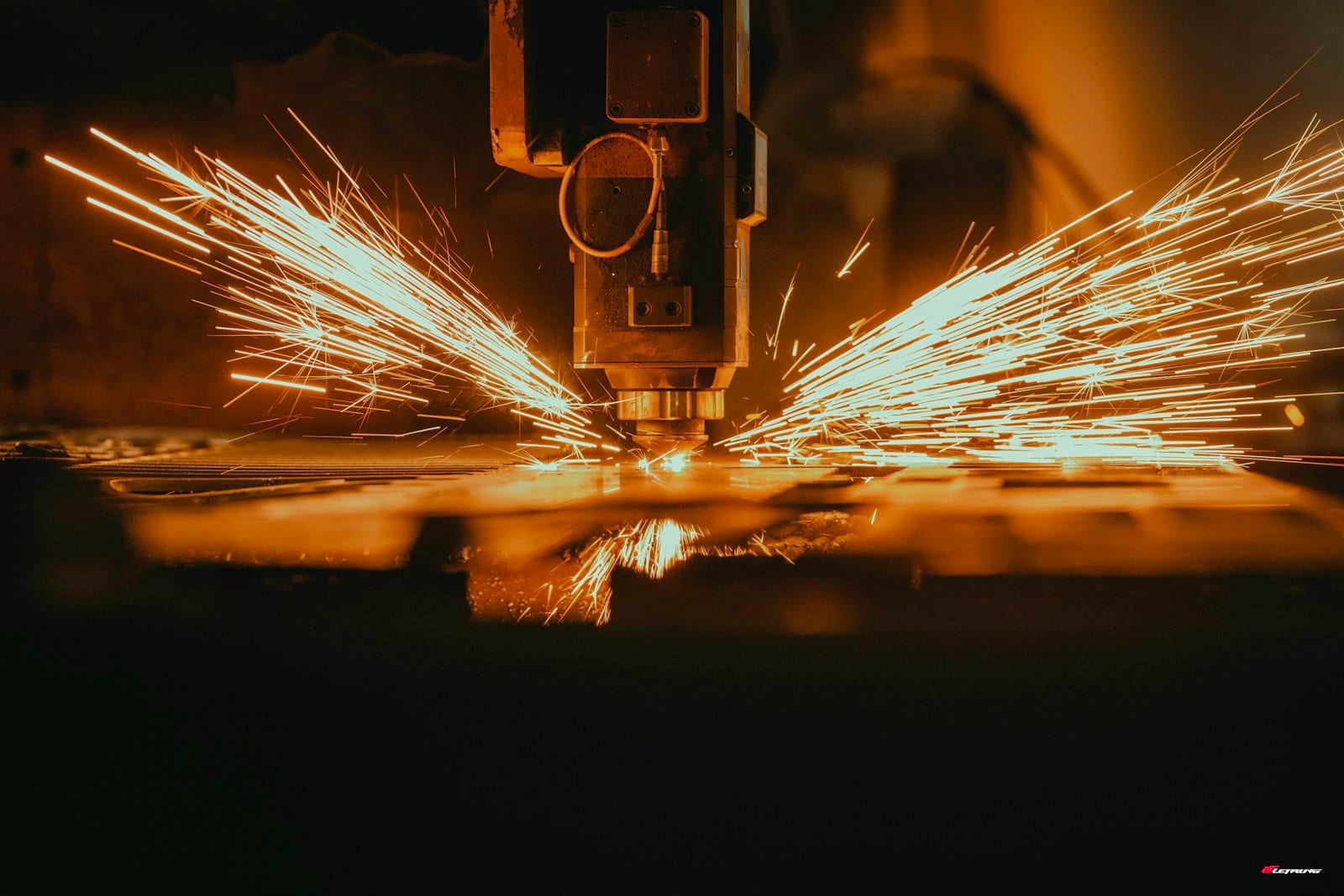
Laser, waterjet, and plasma are the three ways a job shop profile-cuts flat metal. Fiber laser wins for sheet and thin plate that needs tight tolerance and a clean edge; waterjet wins for thick, heat-sensitive, or non-metallic material; plasma wins for thick carbon steel where cost per meter beats precision. Most sheet metal parts under 12 mm are laser parts.
What’s the actual difference?
All three processes cut by moving a narrow energy source along a programmed path through flat stock. What differs is the energy.
Fiber laser focuses a beam to a spot a few tenths of a millimeter wide, melts a narrow kerf, and blows the melt out with assist gas. It is the fastest of the three on sheet, the most precise, and the one with the smallest features. It is limited by power: a 3 kW source like ours cuts mild steel to 12 mm, stainless to 6 mm, and aluminum to 5 mm in production (see how thick a 3 kW fiber laser actually cuts).
Abrasive waterjet fires water at pressures on the order of 4,000 bar (60,000 psi) through a small orifice, entrains garnet abrasive, and erodes a kerf about 1 mm wide. There is no heat, so no heat-affected zone, no oxide, and no thermal distortion. It cuts anything: hardened steel, titanium, aluminum plate, brass, composites, glass, stone, rubber. It is slow and the abrasive is a consumable on every meter of cut.
Plasma passes a high-current arc through a gas to form a jet of ionized gas hot enough to melt and blow away conductive metal. It is fast and cheap on thick carbon steel and can cut stainless and aluminum, but the arc is wide and hot: the kerf runs 2 to 4 mm, the edge bevels, and the heat-affected zone is the largest of the three.
Nevatronix Laser runs fiber laser only, a 3 kW flat sheet cell and a 5-axis tube laser. We do not own a waterjet or a plasma table. This article is the comparison we would want a customer to read before sending us a part that belongs elsewhere.
Laser vs waterjet vs plasma at a glance
The numbers below are typical industry ranges for job-shop equipment, not our quote, except where marked as our cell.
| Factor | Fiber laser | Abrasive waterjet | Plasma |
|---|---|---|---|
| Practical thickness, mild steel | 0.5–12 mm on our 3 kW cell; to ~25 mm on higher-power sources | To 100 mm and beyond | ~3–50 mm, thicker on high-amperage systems |
| Kerf width | ~0.1–0.3 mm | ~0.8–1.2 mm | ~2–4 mm |
| Position tolerance | ±0.05 mm (±0.002 in) on our cell | ±0.1–0.25 mm typical | ±0.5–1.5 mm typical |
| Minimum hole | ~1× thickness; 1 mm on our cell | ~1.5–2× jet diameter, roughly 2 mm | ~1.5–2× thickness; small holes bevel badly |
| Edge quality (ISO 9013) | Range 2 across our envelope | Square, matte, no oxide; not graded under ISO 9013 (non-thermal) | Range 3–4 typical; bevel 1–3° |
| Heat-affected zone | Small (tenths of a mm) | None | Largest of the three |
| Materials | All common sheet metals, including reflective copper and brass on fiber | Any material, metallic or not | Conductive metals only |
| Speed on 3 mm steel | Fastest | Slowest | Fast |
| Speed on 25 mm steel | Impractical on 3 kW | Slow | Fastest |
| Cost driver | Machine time, assist gas | Abrasive and machine time | Consumables (electrodes, nozzles), gas |
Read the thickness row first. It sorts the majority of parts before any other row matters.
How do kerf and tolerance compare?
Kerf is the width of material the cut removes, and it sets the floor for feature size, nesting density, and inside-corner radius.
A fiber laser’s kerf of roughly 0.1 to 0.3 mm means a 1 mm hole in 1 mm sheet, a 0.2 mm inside corner, and parts nested 2 to 3 mm apart. Position holds ±0.05 mm (±0.002 in) with ±0.025 mm repeatability on our cell. That is where fine gasket blanks, kiosk faceplates with dozens of cutouts, and PEM-ready hole patterns come from.
A waterjet’s kerf sits near 1 mm, so the smallest practical hole is about 2 mm and inside corners carry a 0.5 mm radius at best. The jet also lags behind the head on thick material and at speed, producing a taper unless the machine compensates by tilting the head; well-run waterjet shops hold ±0.1 to ±0.2 mm on plate. That is looser than laser on sheet and far better than laser on thick plate, where a laser edge has already degraded past usefulness.
Plasma’s 2 to 4 mm kerf and 1 to 3° bevel put it in a different class. A hole smaller than about 1.5 times thickness comes out tapered and off-round, and position lands around ±0.5 to ±1.5 mm. Plasma parts are drilled after cutting where a bolt has to fit. That is acceptable on structural steel and not acceptable on anything that mates to a machined part.
What does heat do to the edge?
Laser and plasma are thermal cuts; waterjet is not. That single fact decides a large group of parts.
Laser melts a narrow kerf and the surrounding metal cools within a fraction of a millimeter. The heat-affected zone on sheet is small enough that most parts weld, form, and coat without touching it. Two edge conditions do follow from the heat: an oxide layer when mild steel is cut with oxygen assist, and a slight hardening of the edge on medium- and high-carbon steel. Both are manageable, and the nitrogen vs oxygen assist gas guide covers when the oxide matters. Geometry is graded under ISO 9013, and our cell holds range 2 across its rated envelope.
Waterjet leaves the metallurgy untouched. No hardening, no oxide, no distortion, no recast layer. That is decisive for hardened tool steel that must stay hard, for titanium and nickel alloys that crack or contaminate under heat, for parts that will be machined or tapped right at the cut edge, and for anything that is not metal. The edge has a matte, sandblasted texture; the top edge is sharp and the bottom edge can show striations on thick, fast cuts.
Plasma puts the most heat into the part. The heat-affected zone is wider, edges on carbon steel can harden enough to resist drilling, thin sheet warps, and the edge carries dross that is typically ground before welding. For structural plate that will be welded anyway, none of that matters much. For a fitted sheet metal part it disqualifies the process.
What does each process cost per meter?
Cost per meter of cut tracks speed and consumables, and the three processes rank differently at different thicknesses.
On sheet metal from 0.5 to 6 mm, fiber laser is the fastest process by a wide margin and its consumables are assist gas and a nozzle. Waterjet on the same sheet runs an order of magnitude slower and consumes abrasive the whole way, which is why waterjet shops rarely compete for thin sheet. Plasma is fast on thin sheet but its edge and hole quality mean secondary operations, so its low cutting price seldom survives to the finished part.
On medium plate from 8 to 12 mm, laser and plasma converge on speed. Laser keeps its kerf and tolerance advantage; plasma keeps a lower hourly rate. If the edge is going to be welded and no hole has to fit a bolt without drilling, plasma is the cheaper part. If the part has fitted features, laser still wins on the finished cost.
On thick plate above 20 mm, laser at 3 kW is out. Plasma is the lowest-cost process on carbon steel by a large margin and waterjet is the highest, with the difference paid for a square, heat-free, material-agnostic edge.
One more cost line: laser nests tighter than either alternative because of its narrow kerf, which saves material on expensive stainless and aluminum; the flat sheet cell runs sheets to 1500 × 3000 mm (60 × 120 in).
When waterjet still wins
Send the part to a waterjet shop when:
- Thickness is beyond laser range. Aluminum above about 5 mm at our power, stainless above 6 mm, mild steel above 12 mm, and any plate above 25 mm where a square edge is required.
- Heat cannot touch the material. Hardened tool steel, spring steel that must keep its temper, titanium, nickel alloys, and any part that will be machined or tapped at the cut edge.
- The material is not metal. Composites, carbon fiber, acrylic, glass, stone, foam, rubber, and laminates. A fiber laser does not cut most of these at all, and chars the ones it does.
- Reflective, thick non-ferrous stock. Thick copper and brass plate cut on waterjet without the reflection and dross problems a laser meets above a few millimeters.
- Stacked cutting. Waterjet can cut several thin sheets stacked; a laser cannot.
When plasma still wins
Send the part to a plasma shop when:
- It is thick carbon steel with loose tolerances. Base plates, gussets, structural brackets, and weldment blanks from 12 to 50 mm with ±1 mm dimensions and holes that will be drilled or bolted with clearance.
- Speed per meter is the whole cost. Long straight cuts on plate, where plasma’s travel rate and low consumable cost dominate.
- Edge finish is irrelevant. Anything that is welded on every edge and ground where it shows. Plasma does not win on stainless or aluminum below 12 mm, on any part with fitted holes, or on thin sheet, and we would not send those parts to a plasma table even if it quoted lower.
When fiber laser wins (most sheet metal)
For the parts most sheet metal buyers actually order, fiber laser is the correct process:
- Sheet and thin plate: mild steel 0.5–12 mm, stainless to 6 mm, aluminum to 5 mm, brass to 3 mm, copper to 2 mm on our 3 kW cell.
- Tight tolerance and small features: ±0.05 mm position, 1 mm holes, sharp inside corners, dense hole patterns for PEM hardware and fasteners.
- Clean edges with no secondary work: ISO 9013 range 2, weld-ready on nitrogen, ready for our in-house powder coat.
- Tight nesting on expensive material: a 0.2 mm kerf on stainless and aluminum is money saved on every sheet.
- Volume and repeatability: fast pierce, fast travel, ±0.025 mm repeatability from a one-off to a 50,000-piece run.
- Tube and profile: the tube laser cuts round tube 12–220 mm OD and square to 200 × 200 mm, which neither waterjet nor plasma does as a standard job-shop service.
Enclosures, chassis, brackets, faceplates, panels, gasket blanks, and electrical cutouts are laser parts. If your part is in that list and under 12 mm, the process decision is made.
How we’d quote your part
Send a DXF or STEP with material, thickness, and quantity to our quote page. If the part is inside our fiber envelope you will get a range 2 edge and a fast turn. If it is thick plate, a composite, or a heat-sensitive alloy, we will tell you at quote and point you to a waterjet or plasma shop instead.
References
- ISO 9013:2017 — Thermal cutting: classification of thermal cuts and edge quality
- WaterJet Technology Association (WJTA) — waterjet cutting industry association, standards, and safety practices
- AWS standards catalog — thermal cutting processes and structural welding codes
- ASTM A36/A36M — Standard specification for carbon structural steel
- OSHA — laser hazards and safety requirements for industrial laser operations
- SME — Society of Manufacturing Engineers, manufacturing process resources
Frequently asked questions
- Should I use laser, waterjet, or plasma to cut this part?
- Use a fiber laser for sheet and thin plate up to about 12 mm in steel and 6 mm in stainless when you need tight tolerance, small features, and a clean edge. Use waterjet for thick plate, heat-sensitive or hardened metals, composites, glass, and stone, where any heat-affected zone is unacceptable. Use plasma for thick carbon steel where speed and cost per meter matter more than precision. Most sheet metal parts are laser parts.
- Which cutting process has the best edge quality?
- Fiber laser on thin and medium sheet, holding ISO 9013 range 2 with a kerf around 0.1 to 0.3 mm. Waterjet produces a square, heat-free edge with a fine sandblasted texture, but a wider kerf near 1 mm and some taper at speed. Plasma gives the roughest edge, typically several degrees of bevel and a wider heat-affected zone, which is fine for weldments and not for fitted parts.
- Is waterjet cutting more precise than laser cutting?
- Not on sheet metal. A fiber laser holds about ±0.05 mm position on sheet under 6 mm; waterjet typically holds ±0.1 to ±0.2 mm and cannot cut features as small because its jet is roughly ten times wider than a laser beam. Waterjet's precision advantage appears on thick plate above 20 to 25 mm, where laser cuts taper or stop and waterjet stays square. These are typical industry ranges, not our quote.
- Which process is cheapest per part?
- For sheet metal under 12 mm, laser is usually cheapest because it is the fastest of the three and nests tightly. For carbon steel plate above about 20 mm, plasma is cheapest per meter. Waterjet is the most expensive per meter at any thickness because of abrasive consumption and slow travel, and is chosen for its heat-free, material-agnostic edge rather than for price.
- Does laser cutting leave a heat-affected zone?
- Yes, but a small one. A fiber laser's heat-affected zone on sheet steel is typically a fraction of a millimeter, and on stainless and aluminum with nitrogen assist the edge stays bright and weld-ready. Waterjet has no heat-affected zone at all, which matters for hardened tool steel, titanium, and parts that will be machined at the edge. Plasma has the largest heat-affected zone of the three.
- Can Nevatronix waterjet or plasma cut my part?
- No. Nevatronix Laser runs fiber laser only: a 3 kW flat sheet cell and a 5-axis tube laser. If your part is thick plate beyond 12 mm mild steel, a composite, glass, stone, or a heat-sensitive alloy, we will say so at quote and suggest a waterjet or plasma shop. We would rather lose a part than cut it on the wrong process.